Global connector sales reaches US$81.9 billion (Bishop, 2025), of which PCB connections account for more than 25%, mainly divided into Board-To-Board (BTB), Wire-To-Board (WTB), Pin Header, Terminal Block, Socket, etc.
According to multiple research institutions, BTB connectors account for 10-15% of the total connector sales, with a CAGR of about 5-7% by 2030. Among this category, “Floating BTB” is being widely used in smart manufacturing, automotive electrics, telecom, military aerospace and medical applications due to its uniqueness, and its CAGR is estimated to reach 8.5% by 2030.
Features of Floating BTB Connector
1. Tolerance absorption and error compensation- Allows certain range of movement in the X and Y axes, which can compensate for the tolerance during assembly, reduce stress accumulation, and improve product reliability
2. Reduce mechanical stress-It can effectively reduce the stress caused by PCB warping, vibration or thermal expansion, avoid solder joint damage and improve durability
3. Improve contact reliability- The floating mechanism ensures that the contact points are evenly distributed, reducing the risk of poor contact and improving the stability of signal transmission
4. Simplify assembly and alignment-A certain degree of deviation can be tolerated during assembly, making automated assembly easier, improving production efficiency and reducing defective rates
5. Suitable for high-density applications-The floating design is suitable for precision electronic equipment, which helps to improve product performance and life
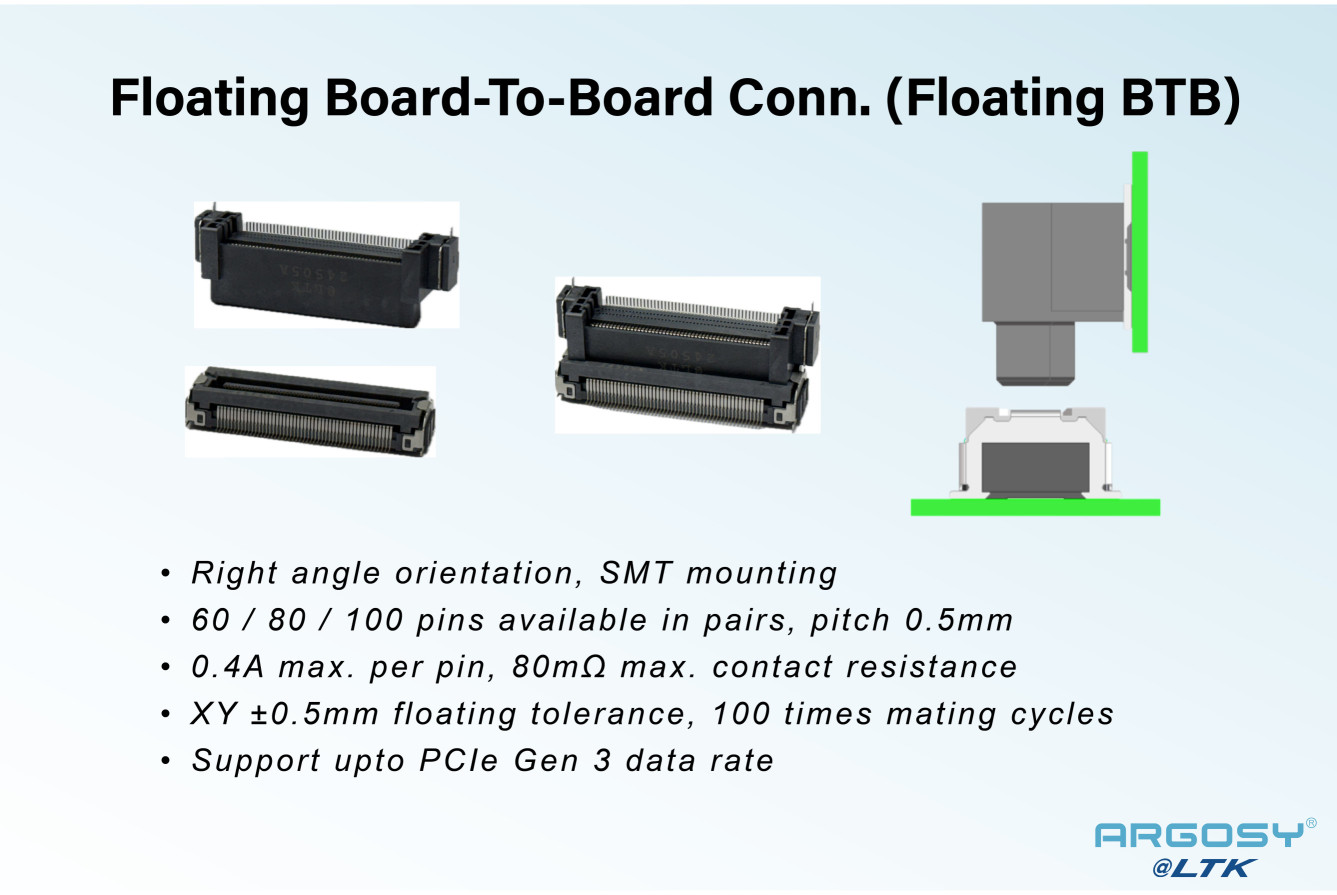
Argosy’s Floating BTB Connector–Receptacle & Plug
Applications
- Automotive electronics, e.g. Infotainment, ADAS, and ECU components
- Smart manufacturing and industrial control, e.g. Robotic and PLC components
- Communication and computing equipment for outdoor or harsh environments, e.g. Router, Switch, Base Station, POE, and IPC components
- Components for medical imaging and diagnostic equipment